Planetary Simulant Database
Free Resource for Regolith Simulant Information
Mineralogy
| Mineral | Abundance (%) |
|---|---|
| Plagioclase | ? |
| Olivine | ? |
| Pyroxene | ? |
| Ilmenite | ? |
Bulk Chemistry
| Oxide | Wt.% |
|---|---|
| SiO2 | 42.8 |
| TiO2 | 6.77 |
| Al2O3 | 12.1 |
| FeO | 16.3 |
| MnO | 0.22 |
| MgO | 6.19 |
| CaO | 11.1 |
| Na2O | 2.22 |
| K2O | 0.20 |
| P2O5 | 0.04 |
| Total | 97.9 |
Physical Properties
| Property | Value |
|---|---|
| Specific gravity | 3.2 |
| Bulk density | 1.5-2.2 g/cm3 | Friction Angle | 41.4-29.8° |
| Cohesion | 0.1-1.5 kPa |
MLS 1/1P Minnesota Lunar Simulant
Simulant Name: MLS-1/1P
Current Status: Not Available
Fidelity: Standard
Developed By: University of Minnesota
Available From: N/A
Publications: Weiblen, P. W., and K. Gordon (1988), Characteristics of a Simulant for Lunar Surface Materials. Second Conference on Lunar Bases and Space Activities of the 21st Century, p.254.
MLS-1 and -1P were developed as general use, high-Ti mare simulants. They were derived from a basaltic sill in an abandoned quarry in Duluth, MN. The MLS-1 version is glass-free, but the -1P variant was produced by passing a portion of the raw material through a plasma furnace to form glass. The chemistry of MLS-1 compared favorably to Apollo 11 soil 10084.
The same group also produced the MLS-2 highlands simulant. None of the MLS simulants seem to be currently available.
Images
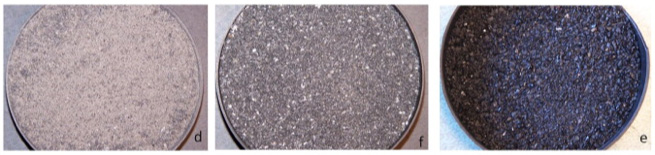
Photographs of (left to right) MLS-1 bulk, MLS-1 coarse fraction, and MLS-1P glass. From Johnson et al. 2013: